Last fall a client called me about his usual move: the annual guys’ golf trip. Same eight guys, same kind of resort, same four rounds in four days. He’d been running it for years and it worked. But this time he said something I’ve now heard from three different people. “Half the group doesn’t really golf anymore. And nobody wants to bring their wife to a golf trip.” Then, almost as an afterthought: “What if we did pickleball instead?”
I booked it. Not because golf is over — it isn’t, the numbers are actually great — but because for his particular group, pickleball solved a problem golf couldn’t. And I’ve watched that same calculation play out enough times now that I’ll say it plainly: pickleball is becoming the group-travel anchor that golf has been for the last forty years. Quietly, without much fanfare, it’s eating the slot.
Here’s the part people get wrong, though. A great pickleball trip isn’t a golf trip with paddles. It’s a different thing, and if you organize it like a golf trip you’ll get a mediocre one. So let me make the case for why this shift is happening, and then tell you exactly what separates a good pickleball trip from a forgettable one.
Why the Golf Trip Worked in the First Place
Before I argue for the replacement, credit where it’s due. The golf trip endured because it’s a genuinely well-designed format, even if nobody designed it on purpose.
Think about what a round of golf actually delivers. You get a shared activity that gives the day a spine. You get status — the course, the clubhouse, the whole ritual signals something. You get four-plus hours of enforced downtime where the pace is slow enough to actually talk. And you get eighteen holes of conversation with rotating partners, which is really the whole point. The golf is the excuse. The conversation between shots is the product.
That’s a sophisticated piece of social engineering. It’s why deals get done on the course and not in the conference room. Any activity that wants to replace it has to clear that bar — shared spine, some status, real downtime, structured conversation. Most fail. Skiing splits the group by ability and ends in silence on a chairlift. A retreat with trust falls makes grown adults want to quit their jobs. Golf is hard to beat.
Pickleball beats it for one specific reason, and it’s not athletic.
The Real Reason Pickleball Is Winning Group Trips
Golf has a participation problem inside a mixed group, and pickleball doesn’t.
A golf trip has a hidden membership test. You’re either a golfer or you’re tagging along. If half your group doesn’t play, or plays badly enough to be self-conscious about it, you’ve effectively split the trip in two. The spouses and partners who don’t golf become a logistics problem to solve — spa day, shopping, “we’ll meet you for dinner.” The trip belongs to the golfers and everyone else is adjacent to it.
Pickleball doesn’t have that test, because almost nobody fails it. You can teach a complete beginner the rules in about ten minutes and have them rallying — badly, happily — inside the first session. That’s not marketing; it’s the actual reason the sport exploded. It’s been the fastest-growing sport in the United States for four straight years, and participation went from roughly four million players to over twenty-four million in about five years. You don’t get growth like that from a sport that’s hard to start. You get it from a sport where a 34-year-old and a 68-year-old can be on the same court ten minutes after one of them has never held a paddle.
That low barrier changes the entire shape of a group trip:
- Everyone’s a participant, not a spectator. Couples come together and both actually play. The non-athlete in the group isn’t sidelined. Nobody’s killing four hours waiting for the real activity to end.
- It’s doubles by default, so it’s relentlessly social. You’re four people on a small court, close enough to talk between points, swapping partners every game. It’s eighteen holes of conversation compressed into twenty minutes, on repeat.
- Short games mean rotation. A game’s over in fifteen or twenty minutes, so people cycle on and off the court constantly. Over an afternoon, everyone plays with everyone. You can’t engineer that on a golf course where you’re locked into one foursome for the round.
- It spans ages and fitness without condescension. Nobody has to be “let win.” A well-seeded game between mismatched athletes is genuinely close, which I’ll come back to, because it’s the whole secret.
None of this makes golf worse. It makes pickleball better for a mixed group — couples, a range of ages, a few people who are athletic and a few who aren’t. That’s most company trips and most friend groups I book. The golf trip optimized for eight men who all play. The world that’s organizing trips now doesn’t look like that as often.
The Thing Most People Don’t Know: Skill Doesn’t Have to Be Lopsided
The objection I hear next is fair. “If we’ve got a former college athlete and someone who’s never played, won’t the games be a blowout?” On a casual public court, yes, sometimes. On a well-run trip, no — and the reason is a rating system called DUPR.
DUPR is the closest thing pickleball has to a universal handicap. It’s now USA Pickleball’s official rating system, and it works on a modified version of the Elo math chess uses — your number moves based on who you beat and who beat you, not on a self-assessment that’s always too generous. A beginner sits around 2.0 to 3.0, a solid recreational player in the 3.5 range, advanced players 4.0 and up.
Why does this matter for a trip? Because it lets you seed games and brackets so they’re actually competitive. Instead of a random draw where the ringer steamrolls everyone, you pair and group people so the matches are close. A close game is fun for both the 4.0 and the 3.0. A blowout is fun for neither. The rating system is what turns a “we have a wide range of skill” problem into a feature — it’s the difference between a trip where the good players get bored and the new players get embarrassed, and one where every game is in question until the last point.
This is the single most important thing a good organizer does, and it’s invisible to the guests. They just notice the games felt fair and they kept getting better matchups. That’s not luck. That’s seeding.
What Separates a Good Pickleball Trip From a Bad One
Pickleball-forward resorts and cruises have multiplied fast. Sandals alone has built something like sixty-plus courts across more than a dozen of their resorts; cruise lines now run daily organized play. The infrastructure is no longer the hard part. The design is. Here’s what I look for before I’ll put a group on a pickleball trip, and what I build in when I run one.
Enough courts. This is the first thing that quietly ruins trips. If you’ve got twenty people and two courts, most of your group is standing in line in the sun. The ratio of players to courts determines whether people feel like they’re playing a sport or waiting for a turn at the DMV. I’d rather a smaller resort with four good courts than a sprawling one with two.
Skill-based seeding, not a free-for-all. Per the DUPR point above — if the games aren’t seeded, the trip self-segregates by ability within an hour, which is the exact problem we left golf to avoid.
A tournament that’s genuinely optional. This is the one people get wrong most often. A bracket gives the competitive people something to chase and adds a spine to the days. But the moment the trip depends on the tournament, you’ve rebuilt the golf problem — now the non-competitors are tagging along again. The format has to be designed so the trip stands completely on its own for someone who never picks up a paddle. The tournament is a layer on top, not the foundation.
Social design beyond the court. Mixers, a welcome session, an evening event, a clinic or two. The pickleball is the spine, but the trip is made in the downtime around it — same as golf. If the only structure is “courts are open 9 to 5,” you’ve planned a gym membership, not a trip.
Pro instruction available. An hour with a real coach early in the trip does two things: it makes the beginners feel less exposed, and it gives the experienced players something to sharpen. It also seeds conversation — people who took the clinic together have something to talk about at dinner.
Recovery and actual downtime. People underestimate how much pickleball they can play before their knees file a complaint. Build in slack — pool afternoons, a spa, a long dinner. The trip is not a tournament with a hotel attached.
A destination worth being at anyway. This is the real test. If you stripped every paddle out of the trip, would your group still be glad they came? If the answer’s no, the destination is wrong. The pickleball should be the reason you all got in the same place, not the only reason to be there.
The Worked Example: Sandals Royal Curaçao, May 2027
Here’s what this looks like when it’s actually designed. It’s the trip I’m running, and it’s the one I point people to when they want to see the principles in practice.
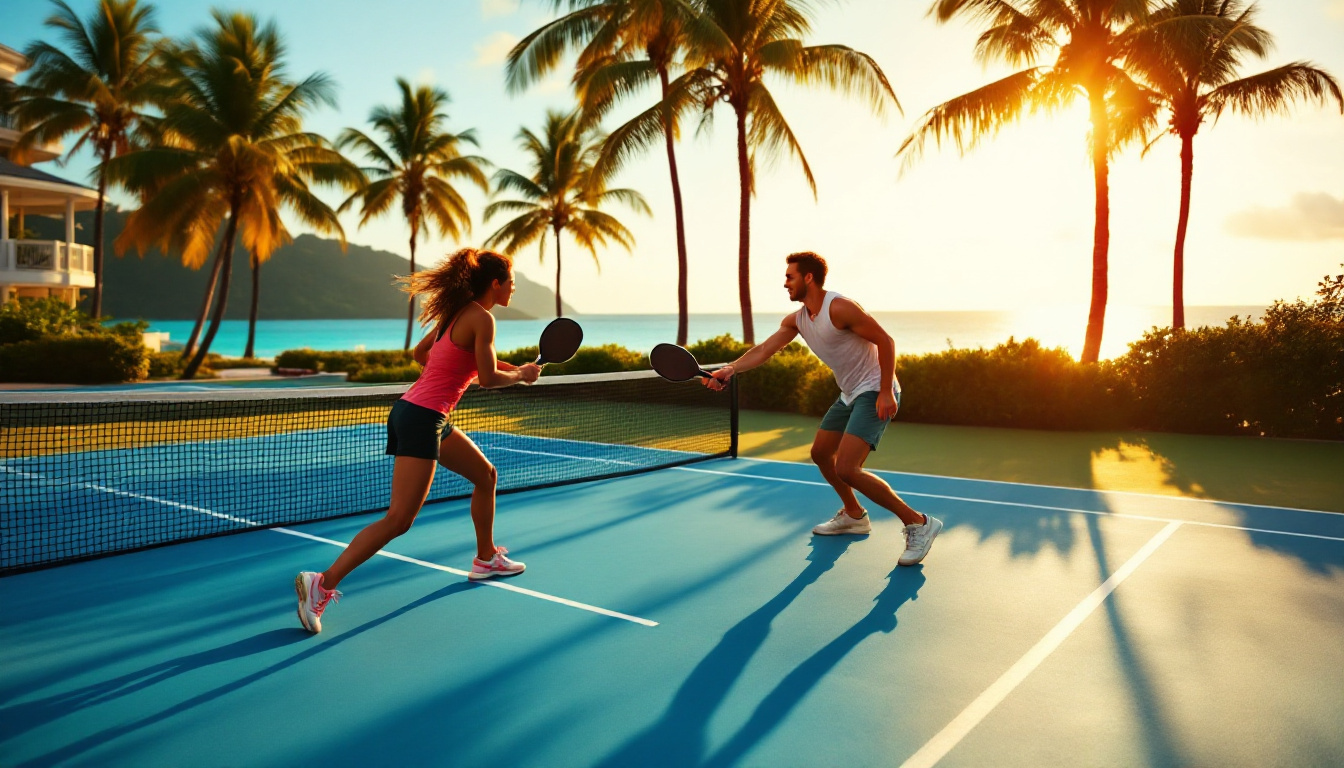
Sandals Royal Curaçao, May 12–16, 2027 — four nights, all-inclusive, oceanfront courts. We’ve got twenty rooms blocked at group rates, and we’re hosting it ourselves. Not brokering it for somebody else’s tournament — designing the trip, seeding the bracket, and handling every booking.
The competitive layer is a DUPR-seeded mixed-doubles “waterfall” bracket — seeded so the games are close, mixed so couples play together, and structured as a waterfall so you keep getting matched into games at your level instead of getting knocked out after one loss. That’s the engine for the people who want to compete.
And here’s the part I care about most: the bracket is completely optional. The trip stands on its own. If you and your partner want to play one casual game and spend the rest of the time on an all-inclusive beach in the Caribbean, that is the trip for you. Couples and singles are both welcome. Nobody’s tagging along, because there’s nothing to tag along to — everyone’s a guest at the same trip, and the pickleball is there for exactly as much or as little as you want it.
That’s the whole thesis in one booking. Shared spine, real status, genuine downtime, structured social time, and a competitive layer that includes the people who want it without excluding anyone who doesn’t. We handle the booking through the Nexion partner network, so the group rates and the logistics aren’t something you’re cobbling together yourself.
If You’re Organizing the Trip
If you’ve run the golf trip for years and you’re starting to notice that half the group doesn’t play, or that nobody’s bringing their partner, or that it’s become eight people doing the same thing in the same place again — pickleball is the move. Not because golf failed you. Because your group changed, and the trip should change with it.
The catch, and I’ll be honest about it, is that a good pickleball trip takes more design than a golf trip does. Golf has its format baked in after a century of refinement. Pickleball is new enough that you have to build the format yourself — the courts, the seeding, the optional bracket, the social scaffolding, the destination that earns its place. Done badly it’s a bunch of people waiting for a court. Done well it’s the trip your group talks about until next year’s.
That design work is exactly the part I do. If you’re tired of golf-or-nothing and you want a group trip where the whole group’s actually in it, reach out and let’s build the right one.