A client asked me last month, half-apologetically, whether she had to “give something up” to travel responsibly. She figured the sustainable option meant a composting toilet and a lecture, and the luxury option meant a buffet line and a smokestack. Pick your guilt.
I told her she had the whole thing backwards. The trips I’d actually fight to get her on are both — and they’re not both by accident. The qualities that make a voyage low-impact are the same qualities that make it feel expensive: fewer people, better access, smarter crew, real quiet. Restraint isn’t the tax you pay for doing the right thing. On the best trips, restraint is the luxury.
That’s not a slogan. It’s a pattern I’ve watched play out across dozens of bookings, and once you see the mechanism, you can’t unsee it.
Why “Eco” Earns the Eye-Roll
Let’s be honest about why your skepticism is healthy. “Sustainable” got strip-mined as a marketing word years ago. A hotel hangs a card asking you to reuse your towel “for the planet” while it ships strawberries in from three continents and runs the air conditioning at meat-locker temperatures. A cruise line buys a few carbon credits, prints a leaf on the brochure, and calls it a day. The word stopped meaning anything because everyone claimed it and almost no one had to prove it.
So I don’t lead with the word. I lead with evidence. When a client tells me they want adventure that holds up to scrutiny, my job is to separate the operators who’ve built sustainability into the bones of the operation from the ones who’ve bolted it onto the brochure. The good news: the real ones are easy to spot once you know what you’re looking at, because they can’t stop telling on themselves with numbers.
The Constraint Is the Product
Here’s the core argument, and it’s worth slowing down for.
In Antarctica, the rules are not optional. Under the IAATO framework that governs tourism on the continent, no more than 100 passengers may be ashore at any one site at any one time, and operators must hold a guide-to-guest ratio of roughly one to twenty on every landing. Ships carrying more than 500 passengers face stricter timing and location limits, and the largest ships often can’t land their guests at all — they cruise past while the small ships go in.
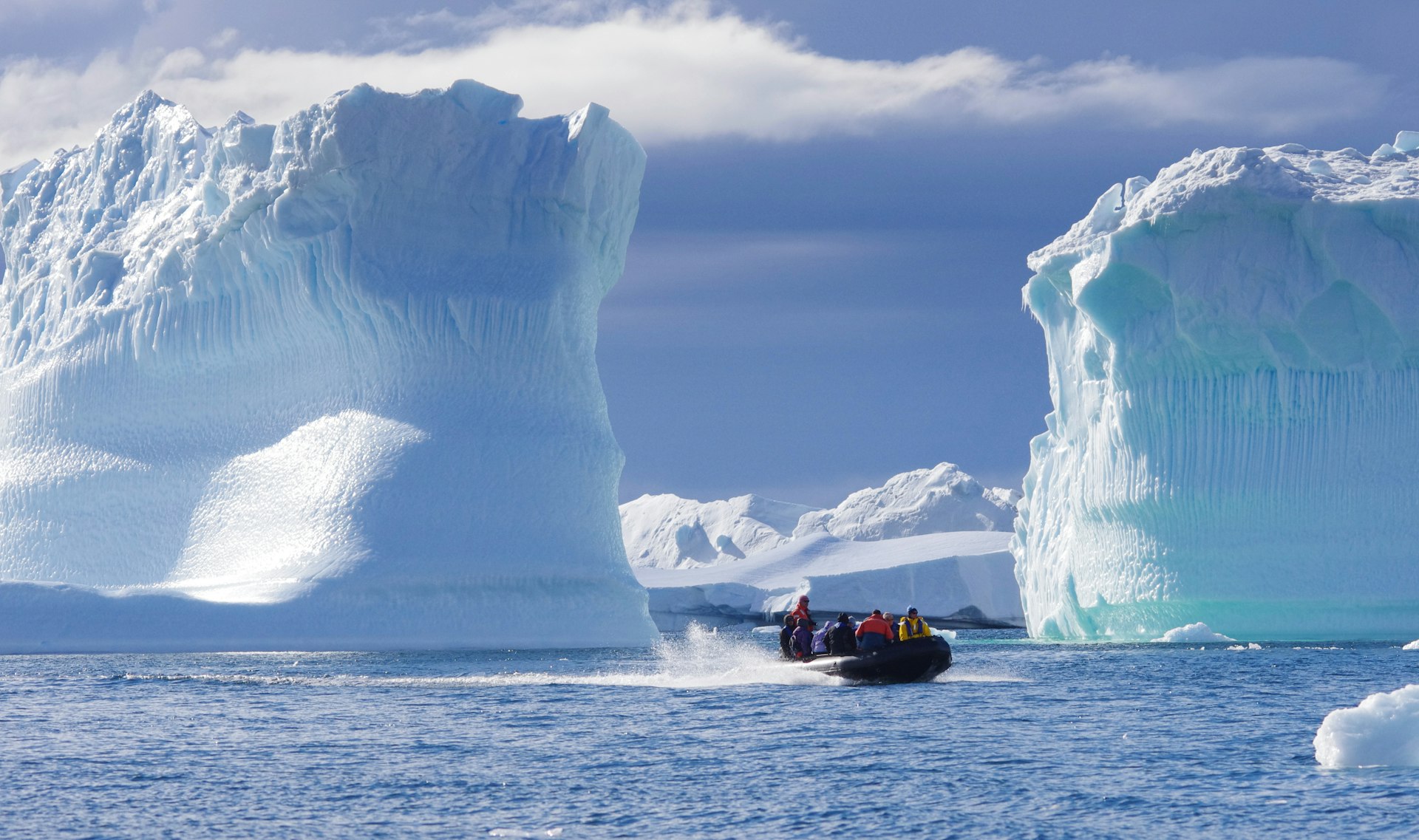
Read that again, because it quietly demolishes the whole “luxury vs. low-impact” framing. A 500-guest ship and a 120-guest ship arrive at the same bay. The big ship runs its passengers ashore in shifts, eating half a day in rotations, or doesn’t land them at all. The small ship puts everyone on the ice in a single Zodiac wave, with naturalists outnumbering the crowds. Which one feels exclusive? Which one is lower-impact? Same answer. The environmental constraint and the premium experience are the identical thing viewed from two angles.
That logic scales beyond the poles:
- Small guest counts mean a naturalist can actually talk to you, not broadcast at you. The vessels I send people on for polar and remote work tend to carry somewhere between 90 and 200 guests for exactly this reason — small enough to land everyone at once, ice-rated enough to reach the places the big ships can’t.
- Local sourcing isn’t a sustainability checkbox; it’s why the meal in front of you tastes like the place you’re standing instead of like a banquet hall in any city on earth.
- Quiet is the rarest luxury of all, and it’s a direct output of the technology. A hybrid ship running on battery power into a fjord arrives in genuine silence. You hear the glacier, not the engine. That silence is both an emissions reduction and the single most expensive-feeling moment of the trip.
Restraint, access, quiet, provenance. Those are luxury words. They’re also low-impact words. The operators who understand this don’t experience a tension between the two — they’ve designed the tension away.
What Actually Earns a Place on My List
This is the part where I have to be careful, because Nexion’s preferred-supplier network is deep and full of excellent companies, most of whom I’ll never write a word about simply because I can’t write about everyone. So I’m not going to play favorites by knocking anyone. I’m going to tell you the criteria — what it takes to earn the spot — and point at operators who happen to meet the bar so you can see what “meeting it” looks like in practice.
Certification that’s audited, not self-declared
Anyone can call themselves green. Far fewer will submit to an outside auditor with the authority to revoke the label. That’s the line I care about.
The Global Sustainable Tourism Council (GSTC) maintains the baseline standard — four pillars and dozens of indicators covering management, community benefit, cultural heritage, and environmental impact — and it doesn’t certify companies itself; it accredits the bodies that do, which keeps the grading honest. B Corp certification puts a company through a third-party impact assessment that has to be re-earned, not bought once and framed. Travelife and EarthCheck both run on published criteria and on-site or independently verified audits — EarthCheck has been benchmarking tourism operators against scientific metrics since the late 1980s.
What that means in the real world: when Intrepid Travel recertified as a B Corp, its independently assessed score went up — past 102 on the B Impact Assessment in 2024, a figure that puts it among the highest-scoring large B Corps anywhere. That number isn’t marketing. It’s the output of an outside body grading the company’s actual practices and being willing to publish the result. That’s the difference between a certification and a logo.
Numbers a third party can check
The operators worth your money quantify their impact and let someone else verify it.
G Adventures publishes what it calls a Ripple Score — the share of your trip’s in-country spending that actually lands with local businesses and services, audited by a third party, averaging in the low 90s across its tours. You can see, before you book, how much of your money stays in the community you’re visiting. Lindblad Expeditions–National Geographic has operated as a carbon-neutral company since 2019, offsetting through a vetted portfolio of projects, and runs its ships as working research platforms — in the 2025–26 Antarctic season alone, its vessels hosted more than a dozen science projects across nearly twenty voyages, with National Geographic scientists and naturalists aboard. The science isn’t a gift-shop diorama. The data leaves the ship and goes into actual research.
Sustainability built into the hull, the kitchen, the building
The deepest tell is when the responsible choice is structural — engineered in, not added on.
On the water, that shows up as propulsion. HX (Hurtigruten Expeditions) runs two purpose-built hybrid expedition ships and was the first cruise company to ban unnecessary single-use plastics across its operation, back in 2018. PONANT’s Le Commandant Charcot is the world’s first LNG-electric hybrid polar vessel, built with a Polar Class 2 hull so it can reach latitudes most ships simply can’t — at a guest count in the low hundreds. These aren’t retrofits. The ships were conceived around the constraint.
On land, the same principle wears a different uniform. Six Senses has run its “Earth Lab” sustainability spaces at its properties since 2017, sources from on-site organic gardens, and operates resorts that bottle their own remineralized water on a reverse-osmosis system — one property keeps something like 10,000 plastic bottles a month out of the waste stream just from that one decision. And the philanthropic arm matters too: Abercrombie & Kent runs a dedicated philanthropy organization that has funded dozens of projects across two dozen countries, from training park ecologists to community enterprise programs — the reinvestment is institutional, not a one-off press release.
I’m naming these companies as illustrations of the standard, not as a ranking. Plenty of operators I work with clear the same bar. The point is the bar itself: audited certification, third-party-checkable numbers, and sustainability engineered into the thing rather than printed on the brochure.
How to Sniff Out the Real Thing Yourself
You don’t need me to vet every trip — though it’s literally my job, so I’d argue you should let me. But if you’re evaluating something on your own, three questions cut through almost all the noise:
- Who audits this, and can they take the label away? A certification that can’t be revoked isn’t a certification. If the “sustainability commitment” is a page on their own website with no outside name attached, treat it as marketing copy, because that’s what it is.
- Show me a number. Emissions, the share of spend that stays local, the count of single-use items eliminated, the research projects supported. Real operators reach for data because they have it. Greenwashers reach for adjectives because adjectives are all they’ve got.
- Is the responsible choice structural or decorative? A hybrid hull, an on-site water plant, a working science lab — those are expensive, permanent decisions. A towel card is not. Look for the choices that would’ve been cheaper to skip.
Notice that none of those questions ask you to sacrifice anything. A smaller ship, food grown where you’re eating it, a crew of scientists, the silence of a battery-powered approach into a fjord — that’s not the cost of doing the right thing. It’s the best version of the trip.
So, No — You Don’t Have to Choose
The false choice my client walked in with — guilt-free or first-class, pick one — falls apart the moment you look at how the good operators actually run. Low-impact and luxury aren’t on opposite ends of a dial. On the trips worth taking, they’re the same point, reached from two directions.
If you want adventure that holds up to scrutiny — the kind where the “eco” claims survive a hard look and the experience is genuinely better for them — that’s exactly what we vet for. Tell me what you’re dreaming about and how much scrutiny you want it to survive, and I’ll point you at the operators who’ve earned it. Get in touch.